
Sculptural Art in Delhi: Explore Unique Art Objects for Modern Spaces
Why Sculptural Art in Delhi Is Shaping Modern Interiors
Walk into any home that holds your attention the moment you enter — the kind that stays with you after you leave — and there is almost always a piece of sculptural art in it. Not a painting, not a wall decal, not a collection of frames. Something three-dimensional that occupies the room, casts its own shadows, and changes how the light reads at different times of day.
The demand for sculptural art in Delhi has grown considerably over the last decade. Homeowners commissioning first homes, interior designers working on premium residential projects, and hospitality brands building signature spaces have all moved toward sculptural pieces as a primary design element rather than a finishing touch. The reason is straightforward: sculptural art does something flat art cannot. It holds space, not just wall.
This guide covers what sculptural art is, which categories are available in the Delhi market, how to select the right piece for your space, and what to look for when you are ready to explore art objects in Delhi seriously.
What Is Sculptural Art and Why Has It Become So Sought After?
Sculptural art is any artwork designed to be experienced in three dimensions rather than two. A painting asks to be viewed from one fixed position. A sculpture invites you to move around it — and rewards you when you do. Its form shifts, its shadows move, and the material reveals new qualities with every change in angle and light.
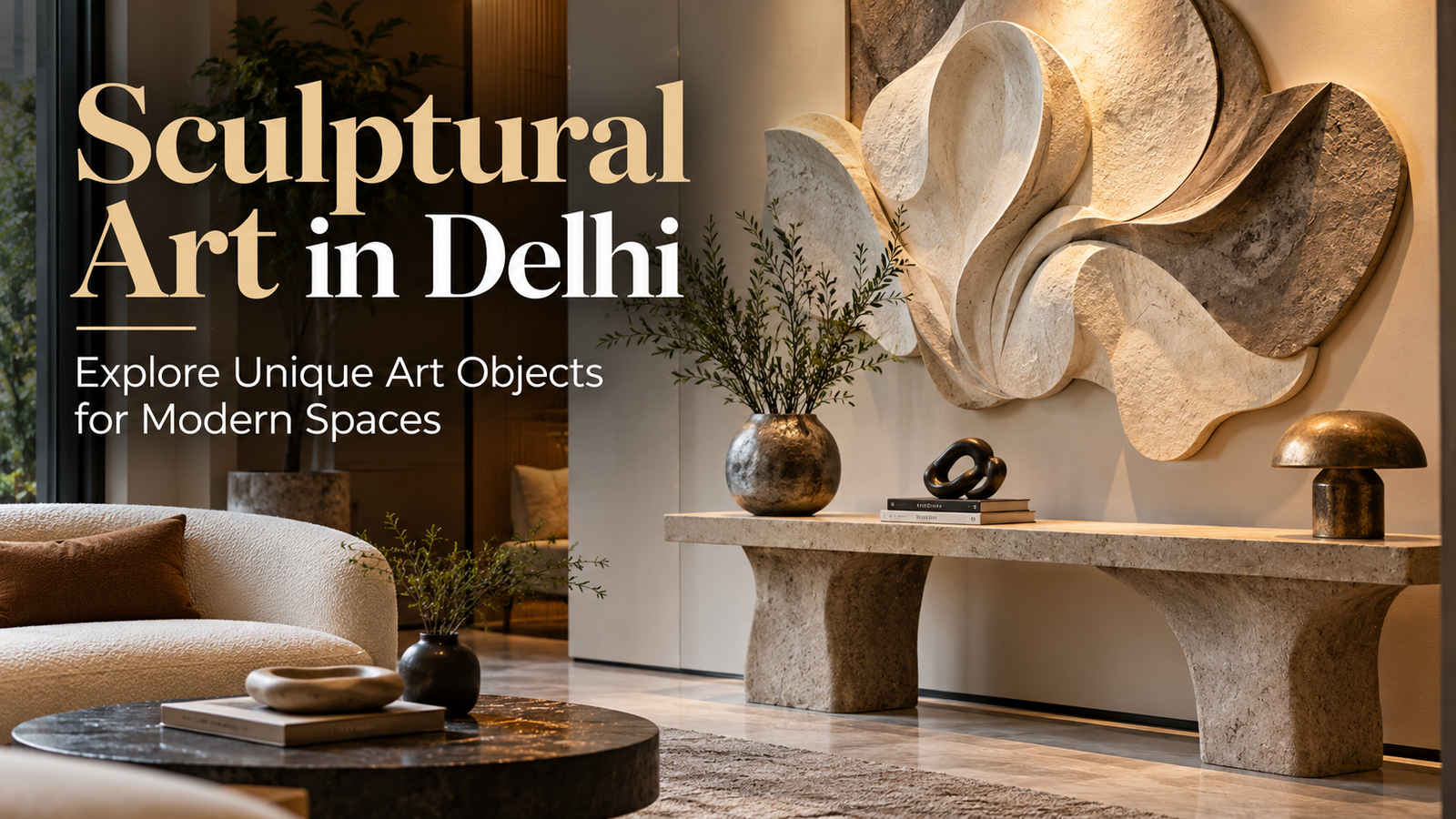
What has changed in the contemporary market for sculptural art in Delhi is the brief. The modern sculptures in Delhi that serious studios are producing today are not the bronze busts or figurative stone work of another era. They are large-format wall compositions that project four inches off the surface, organic resin forms that read as natural stone at close range, full-height mirror frames where the sculpted structure is the art, and console tables where the furniture is simultaneously sculpture.
Understanding Three-Dimensional Design in Contemporary Interiors
Three-dimensional design has become a primary element in how considered interiors are composed. Designers working on premium spaces in Delhi now treat the sculptural layer of a room — the objects that occupy floor and wall space in three dimensions — as carefully as they treat the architectural layer. Sculptural art in Delhi for these projects is not decorative afterthought; it is a structural decision about how the room is anchored and read.
How Form, Material and Craftsmanship Work Together
The most compelling sculptural art objects combine form that reads well from a distance with surface that rewards close inspection. A piece that draws you across a room and then gives you more the closer you get — texture in the resin, hand-worked marks in the surface, depth in the layering — is a piece that holds the space long-term. Material and craftsmanship are what separate sculptural art in Delhi with real presence from decorative objects that fade into the background within months.
Different Types of Sculptural Art Available in Delhi
The market for sculptural art in Delhi spans several distinct categories. Understanding which type suits the brief before beginning a search saves considerable time.
Abstract and Modern Sculptural Forms
Abstract and modern sculptures in Delhi are the most widely commissioned category for contemporary homes and commercial spaces. These are pieces where form and surface are the subject — there is no figurative reference, no narrative content, only the relationship between shape, material, and light. For spaces with clean contemporary architecture, abstract sculptural art allows the room to hold something with genuine visual weight without directing the eye toward a specific story.
Designer Sculptures for Residential and Commercial Spaces
Designer sculptures in Delhi occupy the space between fine art and interior furniture. These are pieces where the design intention is as deliberate as the craftsmanship — consoles with sculpted legs, mirrors with frames that are themselves three-dimensional compositions, wall installations that span full room widths. Designer sculptures in Delhi of this kind are almost always custom commissions, designed for specific spaces rather than produced in multiples.
Art Objects in Delhi — Tabletop and Display Scale
Art objects in Delhi at tabletop and pedestal scale are the most accessible entry point into sculptural collecting. A single well-made object on a console — given enough space around it, properly lit from above or the side — can carry a room that nothing else in the space is doing. These objects range from small abstract forms to elongated vertical pieces that read almost architecturally at display scale.
Site-Specific Installations
The most ambitious category of sculptural art in Delhi is the site-specific commission: a piece or group of pieces designed for one particular wall, entrance, or architectural moment in a space. These are typically the centrepiece of a larger interior project — hotel lobbies, corporate reception areas, or the primary living space of a significant residential commission.
How to Choose Sculptural Art for Your Space
Start with the Proportions of the Space
The proportions of a sculptural piece should respond to the proportions of the room. A sculptural art installation at 2.5 metres will anchor a 14-foot entrance hall comfortably. The same piece in a room with 9-foot ceilings will overwhelm it. Begin with the dimensions of the wall or floor area the piece is going into, not with the piece itself. Any serious source of sculptural art in Delhi will ask for the room dimensions before proposing a form.
Material, Colour and Finish
Contemporary sculptural art in Delhi is produced across several material categories. Composite mixed-media — hand-formed structural objects with layered resin surfaces — is the most flexible for custom commissions. Stone-effect resin finishes suit warm, natural palettes and period architecture. Smooth lacquer finishes read cleanest in minimalist contemporary interiors. Metallic surface treatments work across a wider range of settings but are most powerful used selectively.
Matching Sculptural Art to Interior Design Style
A clean, minimal interior can hold a complex sculptural form because the piece has room to breathe. A richly decorated room generally calls for a quieter form with a strong material presence rather than a complex outline. The most reliable approach is to identify the room’s existing visual hierarchy — what is currently the most powerful element in the space — and design the sculptural art in Delhi to either reinforce or deliberately reposition that hierarchy.
How Art Objects and Designer Sculptures Enhance Interiors
Creating a Focal Point in Living Rooms
The most effective use of a sculptural piece in a living space is as the room’s visual anchor — the one object that every seating position in the room relates to. For this role, sculptural art in Delhi tends to be wall-mounted — a large-format relief installation or a composed wall group — or a full-height freestanding piece positioned against the primary wall. The piece sets the tone for the room before the furniture is read at all.
Adding Character to Offices and Reception Areas
Reception spaces use designer sculptures in Delhi to communicate something about the brand or the owner before a single word is spoken. A commissioning brief for a corporate reception typically specifies the feeling of the piece — assured, forward-looking, grounded — more precisely than it specifies the form. The studio translates that feeling into form and material.
Styling Sculptural Art Objects on Consoles and Shelves
Tabletop art objects in Delhi at display scale work best when they are given space. A single object on a console with clear air around it reads more powerfully than three objects competing for the same surface. Lighting is the most important consideration after placement — a directional light at 45 degrees to the piece creates shadow that becomes part of the composition.
Where to Find Sculptural Art in West Delhi
Sculptural art in West Delhi is produced by studios that work on a commission basis and build in composite mixed-media. Unlike showrooms that source from manufacturers and hold catalogue stock, these studios design and build each piece around the specific brief. Studio visits are the standard starting point for any commission — they allow clients to see completed work, handle material samples, and understand the scale of what is possible.
For clients across Delhi NCR looking for sculptural art in West Delhi, a studio visit is a half-day commitment that clarifies more than any catalogue can. The brief is discussed in person, the material options are reviewed at actual scale, and the finished work from previous commissions gives a clear read of quality and approach.
Tips for Displaying Sculptural Art at Home
Lighting determines more about how a sculptural piece reads in a room than almost any other factor. A wall-mounted installation lit from above with a narrow-beam track light will cast downward shadows that make the composition three-dimensional in a way no photograph can capture. A freestanding floor piece lit from a low angle from one side will cast long lateral shadows that change as the day progresses.
Keep the objects around the sculptural piece subordinate to it in colour and scale. A strong piece of sculptural art in Delhi on a console works best when the objects around it — books, small vessels, a plant — are quiet and set back. The sculpture should be the room’s first sentence, not one clause in a long one.
Why Choose Kora Living for Sculptural Art in Delhi
Kora Living is a Delhi studio that creates sculptural art in Delhi for residential, commercial, and hospitality commissions. Every piece is made to order in composite mixed-media — hand-formed, hand-finished, and built for the specific space it is going into. The studio’s founding team has over a decade of experience in sculptural art and interior objects across Delhi NCR and international projects.
The studio works directly with homeowners, interior designers, and architects. Studio visits are available by appointment at the West Delhi studio, where completed work can be seen, material samples handled, and a brief discussed in person. Every commission is fully custom — dimensions, form, finish, and colour are all designed from scratch for the brief.
Frequently Asked Questions
Q. What is sculptural art and how is it different from decorative art?
Ans. Sculptural art is three-dimensional artwork designed to occupy physical space and be experienced from multiple angles. Unlike flat decorative art — prints, paintings, wall panels — sculptural art engages with the light, architecture, and proportions of the room it lives in. Sculptural art in Delhi today spans wall installations, sculptural consoles, mirror forms, floor pieces, and tabletop art objects.
Q. How do I choose sculptural art for my home in Delhi?
Ans. Start with the dimensions of the space and the intended position of the piece. Then consider the existing palette, material language, and the feeling you are working towards. A studio that produces sculptural art in Delhi can advise on appropriate scale, form, and finish for the specific room. Studio visits before confirming any commission are strongly recommended.
Q. What materials are used in modern sculptures in Delhi?
Ans. Contemporary sculptural art in Delhi uses several material categories: composite mixed-media (a hand-formed structure with layered resin surfaces, suitable for any scale and form), stone and marble, metal and mixed-material combinations. Composite mixed-media is the most flexible for custom commissions because it allows any form, any finish, and any scale without the weight or structural limitations of natural stone.
Q. Where can I find art objects in Delhi that are genuinely handcrafted?
Ans. The most reliable source of genuinely handcrafted art objects in Delhi is a studio that makes its own work rather than sourcing from a catalogue. A visit to the studio will establish quickly whether pieces are made in-house or sourced. Look for evidence of the making process — material samples, work in progress, previous commissions on display — rather than a showroom presentation of finished pieces.
Q. What is the difference between designer sculptures and mass-produced sculptural decor?
Ans. Designer sculptures in Delhi are pieces where the design intention is specific to the commission and the craftsmanship is evident at close range. Mass-produced sculptural decor is produced in large multiples from fixed moulds, which means the form, the finish, and the surface detail are identical across every piece. A designer sculpture made to order cannot be replicated, and that singularity is part of what it contributes to the space it lives in.